Home Loans for Self-Employed Borrowers and 1099 Contractors
Mortgage Solutions for Tradespeople, Business Owners, and Complex Income Earners Across All 50 States
If your tax returns show $90,000 but you actually live on $140,000 because your CPA is doing their job, standard mortgage qualification was not built for you. If you earn six figures driving truck but your overtime and per diem gets ignored by every lender you talk to, the problem is not your income. It is how the lender is reading your file.
Self-employed contractors, 1099 independent workers, skilled tradespeople, and overtime-heavy hourly workers are some of the highest-earning borrowers in America. They are also the most frequently misjudged by the standard mortgage qualification process, which was designed around salaried W-2 employment and a single paystub that matches a tax return. Complex income is not a disqualifier. It is a documentation category. Every major loan program, including FHA, VA, USDA, and conventional financing, allows complex income to be used for qualification when it meets the documentation and continuance standards of that program.
This page explains exactly how mortgage underwriters evaluate 1099 income, self-employment income, Schedule C earnings, overtime, shift differentials, seasonal trades work, per diem, and multiple income streams. It covers the loan programs that actually fit self-employed and 1099 borrowers, the most common reasons mortgage files get declined, and the steps you can take to prepare your file before you apply. If you have been told by another lender that your income does not qualify, there is a meaningful chance the answer was wrong.
BuildBuyRefi.com is a division of The Federal Savings Bank, a federally chartered institution licensed to originate residential mortgage loans in all 50 states. We underwrite and fund loans in-house. We are not a broker. Our lending team is available 7 days a week to take your call, respond to questions through our system, and review your income before you assume you cannot qualify.

Why the Mortgage System Was Not Built for Self-Employed and 1099 Income
The mortgage qualification framework used by most lenders was standardized around a specific income profile: a salaried employee with a predictable paycheck, two years at the same employer, and a W-2 that lines up cleanly with their tax return. That profile makes underwriting simple. It also describes a shrinking portion of the American workforce. Self-employed business owners, 1099 independent contractors, skilled trades professionals, gig workers, freelancers, and hourly workers with significant overtime rarely fit that profile. They earn well. They often earn more than their salaried counterparts in comparable fields. But their income arrives differently, documents differently, and calculates differently under standard underwriting rules.
The result is a qualification process that frequently underrepresents real earning capacity. Borrowers get pre-declined based on paperwork rather than financial reality. That problem is solvable, but solving it requires understanding what underwriters are actually looking for and how to document self-employment, contractor, and variable income in a way that gives them what they need.
How Mortgage Underwriters Evaluate Self-Employed and Complex Income
Mortgage underwriters are not trying to determine how much money you made last month. They are trying to determine how much income they can confidently project you will continue to earn over the life of the loan. The three things underwriters are evaluating in every file are stability, documentation, and likelihood of continuation. Stability means the income has been consistent over time, not just strong in one recent period. Documentation means the income can be verified through tax returns, pay stubs, employer letters, bank statements, or business records depending on the income type. Likelihood of continuation means there is a reasonable basis to expect the income will continue, whether that is an ongoing employment relationship, an established business, or a multi-year pattern of seasonal or variable earnings.
Your job title is not the issue. The income source is not the issue. The question is always whether the income can be documented as stable and likely to continue. When the answer is yes and the documentation exists to prove it, complex income becomes qualifiable income.
What 'Complex Income' Means in Mortgage Underwriting Terms
In underwriting language, complex income refers to any income that cannot be verified through a single pay stub and a standard W-2. It includes income from self-employment, sole proprietor Schedule C earnings, partnership K-1 distributions, S-corporation income, 1099 independent contracting, variable sources like overtime and bonuses, seasonal employment, second jobs, commission-based roles, and multi-source income households. Complex income is not a disqualifier. It is a documentation category. The loan programs that serve self-employed borrowers and 1099 contractors, including FHA, VA, USDA, conventional, and non-QM options, all allow complex income to be used for qualification when it meets the documentation and continuance standards required by each program.

Income Types We See Most Often and How They Qualify for a Mortgage
This section covers the specific income situations that self-employed borrowers, 1099 contractors, tradespeople, and variable income earners most commonly bring to us. The goal is to explain how each income type is actually evaluated under mortgage underwriting guidelines so you know what to expect before you begin the application process.
Self-Employed Mortgage Qualification for Small Business Owners and Schedule C Filers
Self-employed service business owners represent the largest and most documentation-intensive segment of complex income borrowers. This group includes HVAC contractors, plumbing and electrical business owners, roofing companies, landscaping operations, concrete contractors, painting businesses, auto repair shop owners, trucking company owners, cleaning service operators, pest control businesses, consultants, freelance designers and developers, real estate professionals, and anyone else who runs a trade or service-based small business as the primary owner.
The underwriting challenge for this group is not income level. It is net taxable income versus real cash flow. Business owners reduce their taxable income through legitimate deductions: equipment, vehicles, business expenses, depreciation. That is sound tax strategy. The problem is that most mortgage programs base qualifying income on what the tax return shows as net income, not on gross revenue or actual cash flow through the business.
For conventional loans, Fannie Mae's underwriting guidelines require self-employed borrowers to provide two years of personal tax returns with all schedules and two years of business tax returns where applicable. Underwriters review Schedule C for sole proprietors, K-1 distributions for partnership or S-corporation income, and Form 1120-S for S-corporation owners. The two-year average of net income after expenses forms the baseline for qualification. An exception may apply when a borrower has less than two years of self-employment but has at least one year combined with prior related employment showing comparable income.
Fannie Mae self-employment documentation standards are published in the Selling Guide at selling-guide.fanniemae.com. FHA self-employed mortgage guidelines are available at hud.gov.
Certain business expenses may be added back to net income during the underwriting calculation. Depreciation and depletion are the most common add-backs because they reduce taxable income on paper without representing an actual cash expenditure. These add-backs partially offset the write-off problem, but they do not always fully resolve it for borrowers with aggressive deduction strategies. A year-to-date profit and loss statement prepared by a licensed CPA may be required when the most recent tax return is more than a quarter old.
1099 Mortgage Requirements for Independent Contractors and Gig Workers
This group includes subcontract framers, independent electricians, 1099 mechanics, independent welders, oilfield workers, traveling telecom crews, solar panel installers, linemen, independent truck drivers, gig-based construction workers, freelance consultants, and anyone working under 1099 arrangements rather than running their own company. 1099 mortgage qualification depends on how the income is structured. If the borrower files as a sole proprietor with Schedule C, the income is treated as self-employment income and the two-year tax return requirement applies.
For most 1099 borrowers, the two-year history requirement is the primary challenge. Conventional, FHA, VA, and USDA programs generally require a two-year history of 1099 income before it can be used in qualification. An exception may apply when a borrower has a shorter 1099 history combined with documented prior employment in the same trade or field, provided the income is consistent and the documentation supports continuance.
Per diem compensation requires separate attention. When a portion of a 1099 contractor's compensation is structured as per diem for travel and expenses, the taxable versus non-taxable treatment affects how it is counted. Properly documented per diem that is reported as income on tax returns may be includable in qualifying income. Non-taxable per diem reimbursements are generally excluded from qualifying income under standard underwriting guidelines.
USDA income analysis guidance covering 1099 and variable income documentation requirements is available through the Rural Development program handbook at rd.usda.gov.
Overtime and Shift Differential Income: How Underwriters Count Variable Pay
Overtime-heavy hourly workers represent one of the most common and most misunderstood qualification scenarios in mortgage lending. This group includes factory workers, warehouse workers, utility line workers, plant operators, union machinists, longshoremen, refinery workers, and shift-based employees across industrial and service sectors. It also includes nurses, firefighters, police officers, and EMTs, professions where overtime and shift differentials can represent 20 to 40 percent of total annual compensation.
The rule across most major loan programs: overtime income may be included in qualifying income when it has been received consistently for the past two years and is reasonably likely to continue. When those conditions are met, the overtime is averaged over the documented period and added to base qualifying income. The income is real and it is usable. The documentation standard simply requires proving it is not a one-time event.
FHA guidelines include an important nuance: FHA may consider overtime received for as little as one year when it has been consistent and the borrower's employer confirms it is expected to continue. This one-year overtime exception is not available on all programs and requires strong supporting documentation, but it is worth knowing it exists.
FHA income guidelines addressing overtime, bonus, and variable pay are published by HUD at hud.gov. If overtime earnings are declining year over year, underwriters may use a reduced figure or exclude overtime from qualifying income entirely. Rising or stable overtime is the target documentation picture. Shift differentials and per diem allowances follow the same taxable versus non-taxable analysis.
Union Worker and Seasonal Trades Mortgage Qualification
Union workers face specific documentation challenges because their income may vary based on contract cycles, project assignments, work site rotations, and seasonal patterns in the construction and industrial trades. Members of the IBEW (International Brotherhood of Electrical Workers), UA (United Association of Plumbers, Pipefitters, Sprinkler Fitters), Teamsters, Laborers International Union (LIUNA), United Brotherhood of Carpenters, Ironworkers, and Sheet Metal Workers often see meaningful income variation year over year depending on the jobs available through their local. Employer letters from the union local confirming membership standing and income expectation for the current period can support the continuance requirement.
Seasonal trades, including roofing, landscaping, outdoor construction, and agricultural services, require an established multi-year pattern of earning income during certain months, documented consistently across at least two full years. Employment gaps between union jobs or seasonal assignments require explanation letters when they exceed 30 days. Gaps within the same trade or the same union are treated with more flexibility than unexplained cross-industry gaps.
USDA guidelines explicitly address seasonal income requirements at rd.usda.gov.
Second Job Income and Multiple Income Streams in Mortgage Underwriting
Income from a second job may be included in qualifying income when it has been received without interruption for at least two years and there is a reasonable basis to expect it to continue. This applies to nurses taking per diem hospital shifts, factory workers doing side work on weekends, teachers working construction in the summer, military reservists receiving drill pay alongside civilian employment, police officers working off-duty security, and anyone with a documented dual-income history. A second job that started six months ago cannot typically be counted. A second job held continuously for three years almost certainly can. Documenting the ongoing nature of secondary employment through employer verification, pay stubs, and W-2s is part of building the strongest possible file.
Commission Income and Variable Earnings in Mortgage Qualification
Workers in trade-adjacent fields who earn a significant portion of income through commissions include equipment sales representatives, RV and recreational vehicle sales, commercial and residential solar sales, auto sales professionals, insurance agents in service-based markets, and real estate professionals. Commission income follows the same two-year history and continuance framework as overtime and bonus income. The two-year average of commissions is used, and declining commissions in the most recent year are evaluated carefully. A year where commissions dropped significantly relative to the prior year may result in a reduced qualifying figure or, in cases of material decline, exclusion of commission income entirely. The most important thing commission-based earners can do before applying is ensure their most recent two calendar years show stable or improving commission income.
Income Type to Mortgage Program Compatibility: Quick Reference
This table is a general reference guide showing how each type of complex income maps to the loan programs that typically fit best. Actual eligibility depends on the full credit profile, debt ratios, property type, loan amount, and current program guidelines. All programs listed are available in all 50 states through BuildBuyRefi.com.
| Income Type | Primary Programs | Key Documentation | Common Challenge |
|---|---|---|---|
| Self-Employed Business Owner | FHA, Conventional, VA, Non-QM (brokered) | 2 yrs personal + business tax returns, YTD P&L, Schedule C | Write-offs reduce net taxable income |
| 1099 Independent Contractor | FHA, Conventional, VA, USDA, Non-QM (brokered) | 2 yrs tax returns, 1099s, YTD income docs, per diem analysis | 2-year history requirement; declining income |
| Overtime-Heavy Hourly Worker | FHA, VA, Conventional, USDA | 2 yrs W-2s, pay stubs, employer letter confirming continuance | Overtime must average consistently; declining OT may be excluded |
| Union / Seasonal Worker | FHA, VA, Conventional, USDA | Union contract, employer letter, 2 yrs W-2s, gap explanation | Seasonal gaps and variable contract cycles |
| Second Job / Dual Income | FHA, VA, Conventional, USDA | 2 yrs W-2s from secondary employer, employer verification | 2-year uninterrupted history required |
| Commission-Based Earner | FHA, VA, Conventional | 2 yrs W-2s or tax returns, YTD commission statements | Declining commissions reduce or eliminate usable income |
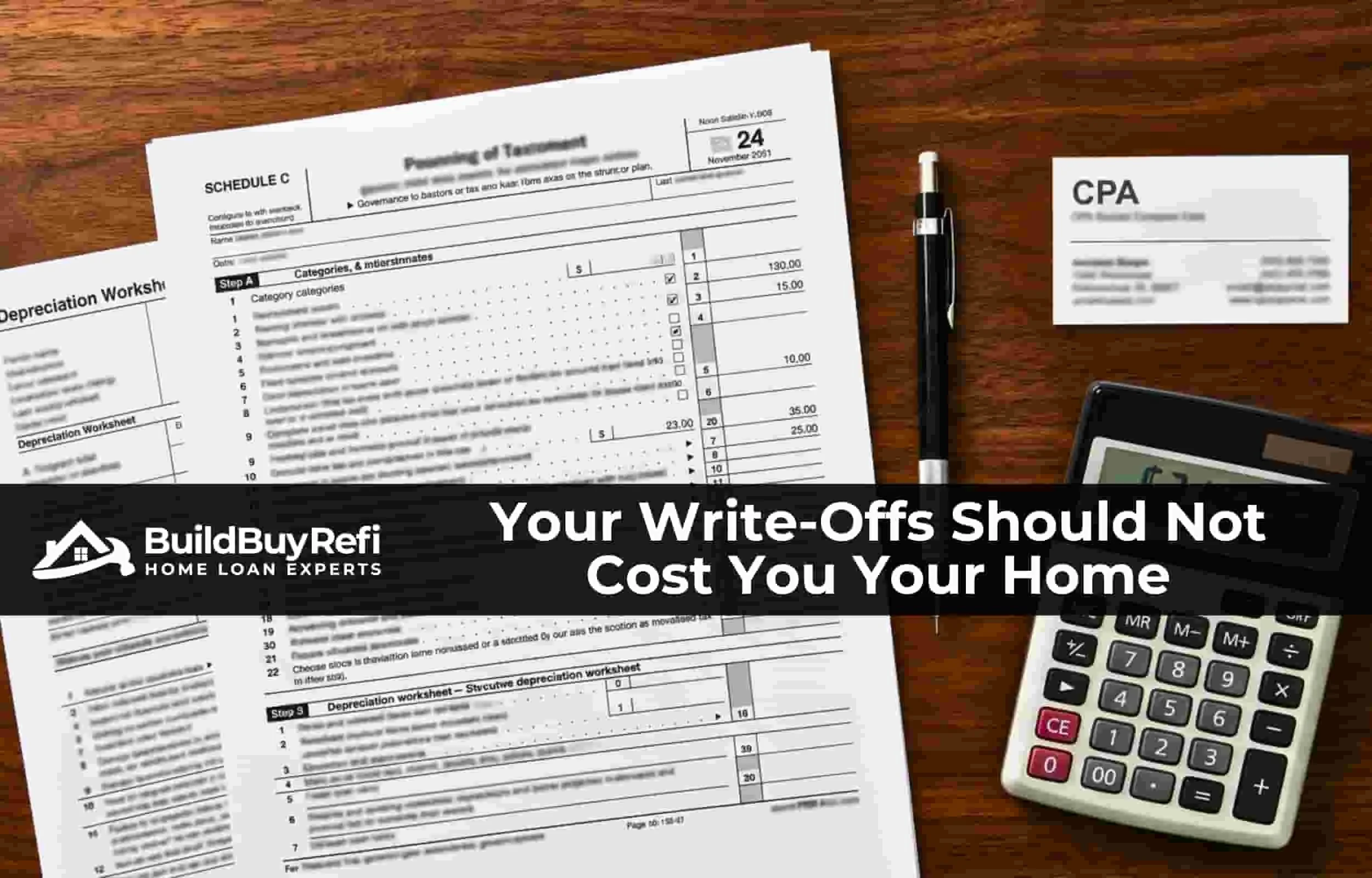
The Tax Write-Off Problem: Why Your Qualifying Income Looks Lower Than Your Real Cash Flow
The single most common frustration we hear from self-employed tradespeople and service business owners is a variation of the same scenario: they earned strong gross revenue last year, their business is growing, they have cash in the bank, and then a lender tells them their qualifying income is a fraction of what they actually earned. The reason is almost always aggressive tax write-offs.
How Schedule C Deductions Reduce Qualifying Income for a Mortgage
Most mortgage programs use net taxable income as the basis for qualifying income on self-employed borrowers. Net taxable income is what remains after business deductions, expenses, depreciation, vehicle costs, home office deductions, equipment purchases, and other Schedule C write-offs are applied. A business owner who grosses $300,000 and writes off $160,000 in legitimate business expenses may show $140,000 in net taxable income on their return, which is already meaningful, but after self-employment tax deduction and other adjustments, the actual qualifying income figure used by an underwriter may be lower than the business owner expected.
This is not a lending problem. It is a structural tension between optimal tax strategy and maximum mortgage qualification. The tax code rewards business owners for reducing taxable income. Mortgage underwriting relies on taxable income. When these two systems collide, borrowers are caught in the middle.
Depreciation and Other Add-Backs That May Restore Qualifying Income
Underwriting guidelines do allow certain deductions to be added back to net income before arriving at qualifying income. Depreciation is the most significant. Because depreciation reduces taxable income on paper without representing an actual cash expenditure, lenders may add it back to the Schedule C net figure. Depletion, business use of home, and certain amortization expenses may also qualify for add-back treatment depending on the loan program and the underwriter's review. Add-backs help but do not always fully resolve the gap. A business owner who wrote off $80,000 in legitimate operating expenses that are not add-back eligible will still see those deductions reduce their qualifying income, even after depreciation and depletion are restored.
Bank Statement Loans and Non-QM Mortgage Options for Self-Employed Borrowers
For borrowers where tax returns materially underrepresent real income and add-backs do not bridge the gap, bank statement programs and non-QM loan options may provide an alternative path. Bank statement mortgages evaluate income based on 12 to 24 months of business or personal bank deposits rather than tax returns, which can more accurately reflect the cash flow available to service a mortgage payment. Bank statement programs are not in-house products at The Federal Savings Bank. When this pathway is appropriate, we can facilitate access through brokered relationships with specialty lenders who offer these programs. The qualification standards, pricing, and terms for non-QM loans differ from conventional, FHA, VA, and USDA loans and should be discussed directly with a loan officer to determine whether the tradeoffs make sense for your situation.
CPA Strategy and Mortgage Timing for Self-Employed Borrowers
If you are planning to purchase or refinance in the next 12 to 18 months, the year before you apply is not the year to maximize write-offs. A significant reduction in net taxable income due to aggressive deductions in that period can materially reduce your qualifying income and potentially delay your approval. This does not mean you should avoid all deductions. It means that if homeownership is a near-term financial goal, a conversation with your CPA about the tradeoff between tax optimization and mortgage qualification is worth having before the end of the tax year. Your loan officer can work alongside that conversation to give you a clear picture of where your qualifying income currently stands and what it would need to look like to support the loan amount you need.

The Most Common Reasons Self-Employed and 1099 Borrowers Get Declined
Most declines for self-employed borrowers, 1099 contractors, and variable income earners are documentation problems, not income problems. Understanding the most common reasons a file gets turned down is the first step toward avoiding them.
The 6 Most Common Decline Reasons for Self-Employed and 1099 Borrowers
1. Insufficient income history. Self-employment, 1099 income, or a new second job that is less than two years old cannot typically be counted. The fix is time, or a program with a documented exception for related prior employment.
2. Declining income trend. If year two earnings are lower than year one, underwriters may use the lower figure or reduce qualifying income further. A strong explanation letter and employer documentation helps. An unexplained decline is harder to overcome.
3. Write-offs that reduce net qualifying income below the needed threshold. The most common issue for Schedule C filers. Add-backs for depreciation help. CPA coordination before the tax year closes helps more.
4. Overtime or bonus income lacking the two-year history. Variable income that recently increased or recently started cannot typically be averaged in until the history is established. FHA's one-year exception exists but requires strong documentation of continuance.
5. Unexplained employment gaps. Gaps of more than 30 days in the two-year employment history require written explanation. Gaps within the same trade are treated differently than cross-industry gaps, but both need documentation.
6. Per diem or non-taxable income counted without analysis. Income that does not appear on tax returns cannot be counted. Per diem must be analyzed for taxable versus non-taxable treatment before inclusion.
Mortgage Programs That Work for Self-Employed, 1099, and Complex Income Borrowers
There is no loan program designed specifically for self-employed borrowers or tradespeople. What exists are programs with enough flexibility in their income documentation standards, credit requirements, and down payment structures to serve borrowers whose income does not arrive in a simple salaried format. When documented correctly, complex income is qualifiable income across all of these programs. BuildBuyRefi.com is licensed to originate all of the following in all 50 states.
FHA Loans for Self-Employed Borrowers and 1099 Contractors
FHA loans are insured by the Federal Housing Administration and are among the most flexible programs available for borrowers with complex income, lower credit scores, or limited down payment funds. Credit scores starting at 580 may be eligible on qualifying FHA programs, with minimum down payment requirements that are lower than most conventional options. For self-employed borrowers, FHA guidelines require a two-year self-employment history with tax returns documenting that history. Variable income including overtime, bonus, commission, and secondary employment may be included when the two-year history and continuance documentation requirements are met. The one-year overtime exception described earlier on this page applies specifically to FHA-insured loans.
FHA self-employed income guidelines are published in the FHA Single Family Housing Policy Handbook.
VA Loans for Self-Employed Veterans and Veteran Tradespeople
Veterans and active duty service members who work in skilled trades, self-employment, or independent contracting after leaving the military have access to one of the strongest loan programs available. The overlap between military occupational specialties and construction, electrical, mechanical, plumbing, transportation, and service trades is significant. VA loans offer no down payment on qualifying purchase transactions, no private mortgage insurance, and competitive terms for eligible borrowers. VA loans are available in all 50 states through BuildBuyRefi.com. For variable or self-employment income, VA guidelines generally require a two-year history with documentation supporting the likelihood that the income will continue.
VA lender guidelines are published by the Department of Veterans Affairs.
Conventional Mortgages for Self-Employed Borrowers with Strong Credit
Conventional loans follow Fannie Mae or Freddie Mac underwriting guidelines and are appropriate for self-employed borrowers and 1099 contractors with stronger credit profiles and sufficient documented income. Conventional programs may allow higher loan amounts than government-backed programs in many markets and offer flexible term and structure options. For self-employed borrowers, Fannie Mae's Selling Guide provides detailed guidance on income documentation requirements including tax return analysis, business income stability evaluation, and the add-back methodology for depreciation and other permitted adjustments.
Fannie Mae's published self-employed underwriting guidelines are available at selling-guide.fanniemae.com.
USDA Rural Development Loans for Self-Employed Rural Borrowers
Self-employed borrowers, 1099 contractors, and tradespeople who live or are planning to buy in rural or semi-rural areas may qualify for USDA Rural Development loan programs, which offer no down payment financing for eligible properties in qualifying geographic areas. Many trades workers in construction, agriculture, landscaping, utilities, and rural services live and work in areas that fall within USDA eligibility boundaries. USDA income analysis addresses seasonal income, self-employment income, and variable income sources directly, applying the stability and continuance framework described throughout this page.
USDA income analysis guidelines are available through the Rural Development Guaranteed Loan Program handbook.

Construction Loans for Self-Employed Builders, Tradespeople, and Owner-Builders
The overlap between self-employed tradespeople and the desire to build rather than buy an existing home is significant. Tradespeople understand construction. Many want to build on land they already own, work with a builder on a custom home, or construct property types that require specialty financing. BuildBuyRefi.com offers three construction loan structures in-house, originating and funding all construction loans without brokering them to outside lenders.
A One-Time Close construction loan combines the construction period financing and the permanent mortgage into a single closing. The borrower qualifies once, closes once, and converts to permanent financing when the build is complete. A Two-Time Close separates construction financing from the permanent mortgage, offering more flexibility in certain scenarios. A Modified Hybrid combines elements of both structures and may be appropriate for specific project types.
BuildBuyRefi.com finances construction on all of the following property types: brick or frame single family homes, condominiums and townhomes, manufactured homes, modular homes, metal homes, barndominiums, 2-4 unit multi-family residences, accessory dwelling units, ICF or insulated concrete foam construction, SIP panel construction, log cabin style homes, timber frame homes, 3-D printed homes, and earth contact homes. This is one of the broadest construction property eligibility lists available from a direct lender nationally, available in all 50 states.
Manufactured and Modular Home Loans for Self-Employed Buyers
For self-employed buyers seeking a lower entry cost path to homeownership, or for buyers who want to place a manufactured or modular home on land they own, BBR offers financing across FHA, VA, USDA, and conventional programs for qualifying manufactured and modular homes. Eligible manufactured homes must be on a permanent foundation, titled as real property, and built after June 15, 1976. Land and home packages are available. Financing for homes on rented or leased land, known as chattel loans, is not offered through our bank.
Renovation Mortgages for Self-Employed Buyers Taking on Fixer-Uppers
Self-employed borrowers and tradespeople who want to buy a property that needs work, and who have the knowledge and instincts to recognize value where others see a problem, are well-positioned for renovation loan programs. These programs combine purchase financing with renovation funding into a single loan, allowing buyers to finance both the acquisition and the improvements through one closing. BuildBuyRefi.com offers FHA 203(k) Standard and Limited renovation loans, VA Renovation loans, Fannie Mae HomeStyle loans, and portfolio renovation programs up to $2 million or more over contract price for qualifying borrowers. Renovation financing is available on brick or frame single family homes, condominiums, townhomes, modular homes, and most other residential property types. Renovation loans are not available on manufactured homes.
Bank Statement and Non-QM Mortgage Options When Tax Returns Do Not Reflect Cash Flow
For self-employed business owners and contractors where two years of tax returns significantly underrepresent real cash flow, bank statement and non-QM loan programs may provide an alternative qualification path. These programs are not standardized agency products and are not offered in-house at The Federal Savings Bank. When appropriate based on the borrower's profile, we may facilitate access through brokered relationships with specialty lenders who offer these programs. Bank statement programs typically use 12 to 24 months of bank deposits to establish qualifying income, which often produces a higher usable income figure for business owners who have significant write-offs on tax returns. Non-QM programs vary widely in structure, terms, and pricing. These are not the right solution for every borrower and should be discussed with a loan officer in the context of your full financial picture.

Before You Apply: Documentation and Preparation Checklist for Self-Employed and 1099 Borrowers
The difference between a smooth approval and a frustrating decline often comes down to preparation. This checklist covers what to gather, what to review, and what to avoid in the period leading up to your mortgage application.
Before You Apply Checklist
DOCUMENTATION: Gather these before you contact a lender
- ✓Two years of personal federal tax returns with all schedules, including all Schedules C, E, or K-1 where applicable
- ✓Two years of business tax returns for S-corporations, partnerships, or multi-member LLCs
- ✓Current year-to-date profit and loss statement prepared or reviewed by a licensed CPA for self-employed borrowers
- ✓Two years of W-2s from all employers, primary employer, secondary jobs, and any overtime-paying positions
- ✓Most recent 30 days of pay stubs showing current base pay plus any overtime, shift differential, or bonus
- ✓Two to three months of bank statements, all accounts, all pages, no gaps
- ✓Business ownership documentation, including business license, DBA registration, articles of incorporation, or equivalent
- ✓1099 forms for each of the two documented years for independent contractor income
- ✓Union membership card and current work agreement for union trades workers
TIMING: Review these before year-end if applying within 12 to 18 months
- ✓Talk to your CPA about write-off strategy. The year before you apply is not the year to maximize deductions if your net qualifying income is already near the threshold.
- ✓Request an income analysis from a loan officer before filing your taxes, not after, so there is still time to adjust if needed.
- ✓Avoid starting new business entities or changing your filing structure in the year before applying, as this can reset the income history clock for underwriting purposes.
WHAT TO AVOID in the months before applying
- ✓Do not open new credit accounts. New credit inquiries and new debt can reduce qualifying income ratios.
- ✓Do not make large undocumented deposits. Unexplained deposits in bank statements require sourcing documentation and can delay underwriting.
- ✓Do not change employers or transition from W-2 to self-employed immediately before applying without discussing the timing with your loan officer first.
Illustrative Mortgage Scenarios for Self-Employed and 1099 Borrowers
The examples below are for consumer education only. They illustrate how different income types translate into underwriting documentation requirements and outcomes. They are not guarantees of approval, specific qualifying amounts, or projected loan outcomes. Actual qualification depends on the full credit profile, debt ratios, property type, loan program, and current underwriting standards.
Illustrative Scenario 1: Self-Employed HVAC Contractor in Texas
Marcus has owned his HVAC service business in the Dallas-Fort Worth area for six years. His gross revenue runs around $320,000 annually, but he and his CPA have historically maximized depreciation on his service vehicles, tools, and equipment to manage his tax exposure. When Marcus first approached a national retail lender shopping for a $375,000 conventional loan, he was told his qualifying income worked out to approximately $71,000, far below what he expected based on his cash flow and bank balances.
When his file was reviewed at BuildBuyRefi.com, a loan officer identified that his Schedule C depreciation add-back was not being applied across both years. After properly restoring the depreciation add-back and averaging the result, his qualifying income basis improved to approximately $98,000, enough to support the 30-year conventional loan he needed on his target property.
This scenario is illustrative only. It does not represent a guarantee of results or a specific loan approval. Actual outcomes depend on the full credit profile, documentation, and current underwriting standards.
Illustrative Scenario 2: IBEW Union Electrician with Overtime in Ohio
Diane is a journeyman electrician with IBEW Local 683 in Columbus and has been with the same local for nine years. Her base wage works out to $78,000 annually, but she routinely works overtime on commercial projects and has averaged an additional $22,000 per year in overtime for the past three years. When she applied for a mortgage on a $340,000 home, a regional lender told her the overtime could not be counted because it was not guaranteed under her union contract.
In reality, consistently documented overtime over a two-year period with a reasonable expectation of continuation may be included in qualifying income under FHA and conventional guidelines. With a documented two-year average of $22,000 in overtime and an employer letter from her IBEW local confirming the pattern of commercial project assignments, Diane's qualifying income basis improved to approximately $100,000, which gave her the debt-to-income ratio she needed on her target purchase.
This scenario is illustrative only. It does not represent a guarantee of results or a specific loan approval. Actual outcomes depend on the full credit profile, documentation, and current underwriting standards.
Illustrative Scenario 3: Teamsters Owner-Operator Truck Driver with Declining Income Year
Ray is a Teamsters-affiliated owner-operator truck driver filing 1099 income who had a strong year two years ago at $82,000 in net income after expenses, followed by a slower year at $68,000. A lender reviewing his file without context would see a declining income trend of roughly 17 percent and either apply the lower figure to qualifying income or reduce it further.
When Ray provided documentation showing the prior year's slowdown was tied to a period of rig maintenance and downtime following an engine rebuild, and that his current year income was tracking back above prior levels, the underwriter was able to evaluate the decline as temporary and explainable rather than structural. With a CPA-prepared year-to-date P&L showing recovery, the two-year average of approximately $75,000 was used rather than the lower figure.
This scenario is illustrative only. It does not represent a guarantee of results or a specific loan approval. Outcomes for declining income are evaluated case by case and are not guaranteed to follow this pattern.
Frequently Asked Questions About Self-Employed and 1099 Mortgages
Can a self-employed borrower or 1099 contractor qualify for a mortgage?
Yes. Self-employed borrowers, 1099 contractors, gig workers, and freelancers can qualify for every major mortgage program including FHA, VA, USDA, and conventional loans. The primary requirement is two years of documented self-employment or 1099 income history, typically verified through tax returns with all schedules. Variable income sources including overtime, bonuses, and commissions may also be included when they have been received consistently and can be documented as likely to continue.
What is the two-year rule for self-employed mortgage qualification?
Most major loan programs require that self-employment income, 1099 income, and other variable income sources be documented over a two-year period before they can be used in qualification. This reflects the underwriting principle that income must be stable and likely to continue, not just present at the time of application. Exceptions exist in limited circumstances, such as when a borrower has one year of self-employment combined with prior related employment history in the same field. Exceptions are program-specific and require documentation.
Does overtime income count toward mortgage qualification?
Variable income including overtime, bonuses, and shift differentials may be included in qualifying income when it has been received consistently and can be documented as likely to continue. Most programs require a two-year history. FHA guidelines include a limited exception for overtime received for as little as one year when documentation of continuance is strong. The income is averaged over the documented period rather than taken at its highest single-year value.
What if I switched jobs but stayed in the same trade or industry?
Changing employers within the same industry or trade is generally treated differently from a career change. If you have been an electrician for ten years and recently changed electrical companies, an underwriter is more likely to view your employment history as stable than if you changed industries entirely. Gaps of more than 30 days between positions typically require a written explanation. Same-industry transitions are evaluated on a case-by-case basis with supporting documentation.
My tax write-offs make my income look much lower than it really is. What are my options?
This is one of the most common challenges for self-employed tradespeople and business owners. The primary options are: use permitted add-backs such as depreciation and depletion to partially restore qualifying income from the Schedule C calculation; work with a loan officer to determine whether your current qualifying income supports the loan amount you need; and evaluate whether adjusting your tax strategy in an upcoming year would bridge the gap. In cases where tax return income is substantially lower than real cash flow, bank statement programs may be evaluated as an alternative, though these are brokered products with different terms than agency loans.
What loan programs work best for self-employed contractors and 1099 workers?
The right program depends on the full picture including credit profile, down payment, property type, loan amount, and how the income documents. FHA offers the most flexibility on credit score and down payment for self-employed borrowers who can document two years of consistent income. Conventional programs may offer better terms for borrowers with stronger credit and a clean two-year income history. VA is available for eligible veterans regardless of self-employment status. Non-QM and bank statement programs are options when agency qualifying income is insufficient, facilitated through brokered relationships.
Can I use bank statements instead of tax returns to qualify for a mortgage?
Standard agency programs, including FHA, VA, USDA, and conventional, require tax return income documentation for self-employed borrowers. Bank statement mortgages are non-QM products that use 12 to 24 months of deposit history in place of tax returns to establish qualifying income. These are not in-house products at The Federal Savings Bank and are accessed through brokered specialty lenders when appropriate. A loan officer can help determine whether a bank statement program is likely to produce a better qualifying outcome than tax return documentation on an agency program.
Do construction loans work for self-employed tradespeople who want to build their own home?
Yes. Construction loans are available through all three structures, One-Time Close, Two-Time Close, and Modified Hybrid, in all 50 states through BuildBuyRefi.com. Self-employed tradespeople who want to build on land they own or construct specialty property types including barndominiums, log cabins, ICF construction, SIP panel homes, metal homes, and others are eligible. The income documentation requirements mirror those of the permanent loan program the construction loan converts to.
What is the difference between a One-Time Close and a Two-Time Close construction loan?
A One-Time Close construction loan involves a single closing for both the construction period and the permanent financing. The borrower qualifies once, closes once, and the loan converts to the permanent mortgage when construction is complete. A Two-Time Close involves separate closings for construction and permanent financing. One-Time Close reduces total closing costs and eliminates re-qualification risk at an unknown future rate. Two-Time Close offers more flexibility in certain scenarios. A modified hybrid structure combines elements of both.
Are manufactured home loans available for self-employed buyers?
Yes. Manufactured home loans are available across FHA, VA, USDA, and conventional programs for eligible manufactured homes on permanent foundations, titled as real property, and built after June 15, 1976. Land and home packages are available. Financing for manufactured homes on rented or leased land, known as chattel loans, is not offered by The Federal Savings Bank. Income documentation requirements are the same as for other property types under each program.
What documents should I gather before applying as a self-employed or 1099 borrower?
The core documentation for most complex income borrowers includes two years of personal federal tax returns with all schedules, two years of W-2s from all employers, recent pay stubs from the past 30 days, two years of business tax returns where applicable, a current year-to-date profit and loss statement from a CPA for self-employed borrowers, bank statements from the past two to three months, documentation of any secondary income sources, and employer letters for overtime or variable income when required by the program. The Before You Apply Checklist earlier on this page provides a complete reference.
How does my CPA tax strategy affect mortgage timing?
If you plan to apply for a mortgage in the next 12 to 18 months, the tax deductions you take in the upcoming year will affect your qualifying income when that return becomes part of your documentation. Borrowers who maximize write-offs in the year before applying often discover that their qualifying income is lower than their earnings would suggest. A conversation with your CPA about the tradeoff between tax optimization and mortgage qualification, coordinated with input from your loan officer, is one of the most effective preparation steps a self-employed borrower can take.
Is there a minimum credit score for self-employed mortgage programs?
Credit score minimums vary by program. FHA programs at BuildBuyRefi.com may be available with credit scores starting at 580 on qualifying programs. Most government programs require a minimum of 640 on standard underwriting. Conventional programs typically require higher credit scores for the most favorable terms. Non-QM and bank statement programs have their own credit requirements that vary by the specific product and lender. A preliminary credit review during prequalification will clarify which programs are available based on your current credit profile.
What does 'likely to continue' mean in mortgage underwriting?
Likelihood of continuation is one of the three core criteria underwriters use to evaluate income alongside stability and documentation. It means there is a reasonable basis to expect the income will persist beyond the closing date. For employed borrowers, this is supported by employer verification of ongoing employment and the terms of any variable compensation. For self-employed borrowers, it is supported by the history of the business, current contract activity, and documented business stability. For seasonal or commission-based earners, prior year patterns and current period activity both contribute to the continuance assessment. Income without a clear basis for continuation may be excluded or reduced by underwriters.
How do I get started if my income situation is complicated?
The best first step is an income review before you are deep into the application process. Call 844-999-0639 or complete the qualification form at buildbuyrefi.com/check-eligibility. A loan officer will review your income documentation, identify which programs you are likely to qualify for, flag any income documentation gaps that need to be addressed, and give you a realistic picture of where your qualification stands before you begin the formal application process.
Estimate Your Qualifying Income Before You Call
The number a lender uses to qualify you is often different from what you expect based on your earnings. If you are self-employed, the qualifying figure starts with your net taxable income after deductions, not your gross revenue. If you earn overtime, only the consistently documented portion counts. This estimator walks you through the same basic calculation an underwriter applies so you can see where you stand before you start the application process.
Enter your figures below. The results update automatically and are for general education only. They are not a pre-qualification or a guarantee of any loan outcome. When you are ready to get an actual income review, call us or start the eligibility form and a loan officer will walk through your specific file with you.
Year 1 — Most Recent Tax Return
Year 2 — Prior Tax Return

Get Your Income Reviewed Before You Assume You Do Not Qualify
The most common reason self-employed borrowers and 1099 contractors do not pursue homeownership is the assumption that their income situation is too complicated to qualify. That assumption is often wrong. The mortgage system is more flexible for complex income than most borrowers realize. It requires documentation, preparation, and a lender who understands how to structure a file that reflects real income. For borrowers who have stable earnings, a consistent work history, and income that can be documented, the path to qualification exists across multiple programs and property types.
BuildBuyRefi.com is a division of The Federal Savings Bank. We originate loans in all 50 states. We underwrite in-house. Our lending team is available 7 days a week to take calls, respond to questions through our system, and review your income before you assume you cannot qualify. If your income is complicated, talk to us before you assume it will not work.
If your income is complicated, talk to us before you assume it will not work.
Our team takes calls 7 days a week.
How We Make Money and How We Are Compensated
The Federal Savings Bank earns revenue when residential mortgage loans are funded. Loan origination compensation is disclosed on the Loan Estimate and Closing Disclosure provided to every borrower. BuildBuyRefi.com does not receive referral fees from third parties for connecting consumers with specific services. Brokered loan products, including bank statement and non-QM programs when applicable, involve compensation disclosures specific to those arrangements and are reviewed with borrowers individually before proceeding. Consumers are encouraged to ask questions about compensation before proceeding with any loan application.
Risk and Limitations
Not all income types can be used on every program. Income lacking the required two-year history, income that is declining significantly, income that cannot be documented, and income from new self-employment of less than one year may not be usable or may be limited.
Qualification is not guaranteed. Complex income increases file complexity and may require additional documentation, underwriting time, and conditions. Not all borrowers with complex income will qualify for every program described on this page.
Loan programs, qualifying standards, geographic availability, and program guidelines are subject to change. Information on this page reflects general underwriting principles and may not reflect current program-specific guidelines at the time of your application.
Approval of one component of a loan application does not guarantee approval of all components. Income qualification, property appraisal, title review, and other conditions must all be satisfied for a loan to close.
The optional unsecured consumer loan of up to $50,000 is a separate program. Not all consumers will qualify. Subject to credit approval. Consumer loan proceeds may not be used for a down payment.
Real estate commission savings through our participating real estate firm are a separate program and are not a component of mortgage loan origination. Learn more at buildbuyrefi.com/real-estate-commission-savings.
This page does not constitute legal advice, tax advice, or financial planning guidance. Consumers should consult appropriate licensed professionals for advice specific to their situation.

About BuildBuyRefi.com and The Federal Savings Bank
BuildBuyRefi.com is a division of The Federal Savings Bank, a federally chartered institution and one of the largest privately held veteran-owned banks in the United States. The Federal Savings Bank underwrites, funds, and services residential mortgage loans in-house across all 50 states. It is not a broker. All loans close in the name of The Federal Savings Bank. The institution is Member FDIC, Equal Housing Lender, and has been independently recognized by national publications, consumer platforms, and industry organizations for mortgage lending excellence. Licensing can be verified at any time through NMLS Consumer Access using NMLS# 411500.
- Best Overall Construction Lender, Investopedia
- Best VA Construction Lender, Investopedia
- Best Manufactured Home Lender, Investopedia
- Top Mortgage Workplaces, Mortgage Professionals Association
- Top Rated Local Winner, 2019 and 2020
- Featured in national publications and broadcast
- As Featured In Investopedia, The Mortgage Reports, Military.com, BobVila.com, Military Makeover with Montel
Why You Can Trust This Information
- Written by the BuildBuyRefi Lending Team and reviewed by our Compliance Team
- Published by a federally chartered, FDIC-insured institution (NMLS# 411500)
- Updated April 18, 2026; change log maintained above
- Structured under federal lending guidelines and applicable state regulations in all 50 states
- External references to Fannie Mae Selling Guide, FHA Handbook, VA Lenders Handbook, USDA program guidelines, CFPB, HUD, and NMLS included throughout
- Privacy Policy and Terms and Conditions linked throughout this page
- Lending team available 7 days a week at 844-999-0639 and through our response system
Program Governance and Compliance Oversight
This page is maintained by the compliance and lending operations teams at The Federal Savings Bank under the BuildBuyRefi.com brand. Content is reviewed by the compliance team prior to publication and updated periodically to reflect regulatory changes, loan program updates, and changes to federal agency guidelines. If you identify information you believe may be outdated or inaccurate, please contact us using the information in the Consumer Support section below.
Consumer Support and Contact Information
BuildBuyRefi.com is a division of The Federal Savings Bank. Our lending team is available to answer questions about income documentation, loan program eligibility, construction financing, and all other aspects of the mortgage process.