Down Payment Assistance Programs With Forgivable Options: Up to 101.5% Financing Across All 50 States
Forgivable and Repayable Options Available With FHA and Conventional Financing. Delegated In-House Underwriting. Funds That Never Run Out. National, State, and Local DPA Programs Supported on a Case-by-Case Basis.
If the monthly payment on a home is something you can afford, but the down payment is the reason you have been renting for years, you are not alone and you have not reached the end of the road. For most households, the barrier to homeownership is not credit and it is not monthly affordability. It is the upfront cash required at closing.
Down payment assistance programs exist to address that specific problem, and the program we offer in-house at BuildBuyRefi.com is one of the most flexible options available in the market today.
This page explains exactly how down payment assistance works, the two repayment options we offer in-house, the state and local programs we support on a case-by-case basis, and every detail a qualified buyer needs to understand before beginning the application process. If you have been told you cannot buy a home because you do not have the down payment saved, that answer was almost certainly incomplete.
- Two in-house down payment assistance options: a 3-Year Forgivable Option and a 10-Year Repayment Option
- Up to 101.5% combined loan-to-value financing when layered with FHA, available with Conventional pairing on qualifying structures
- Funds may be used for down payment AND closing costs, a meaningful difference from many DPA programs
- No first-time homebuyer requirement, no income limits, and delegated in-house underwriting
- In-house program available in 49 states (not available in New York); forgivable option additionally unavailable in Washington State
- National, state, and local DPA programs supported on a case-by-case basis, including in New York
- Down payment assistance is not available on our construction or renovation loan programs
Down payment assistance is a structured financing solution that allows qualified home buyers to cover the required down payment and often the closing costs through a second lien that sits alongside the primary mortgage. It is not a grant distributed from taxpayer funds, and the in-house program we offer is not a gift. It is a loan with defined terms, structured to remove the upfront cash barrier that prevents otherwise-qualified buyers from purchasing a home today rather than three to five years from now.
Our in-house down payment assistance program offers two repayment structures so buyers can choose the option that best fits their financial plan. The 3-Year Forgivable Option carries a 0% interest rate, requires no monthly payments during the forgiveness period, and is forgiven after three years of continued owner-occupancy with no default on the first mortgage. The 10-Year Repayment Option is a fully amortized 10-year second lien at an interest rate set at the first mortgage note rate plus 2%, with monthly payments that begin at closing and may be combined with 2/1 buydowns and High Balance loans.
The in-house program we offer is available in 49 states and closes in the name of The Federal Savings Bank. It is not currently available in New York. The 3-Year Forgivable Option is additionally not available in Washington State. For buyers in New York or for any buyer who may prefer a state or local program, we also support national down payment assistance programs from organizations like the National Homebuyers Fund and Chenoa Fund, state housing finance agency programs in every state that offers one, and county-level and city-level DPA programs on a case-by-case basis.
This page is for owner-occupied primary residence buyers who qualify on income and credit but do not have the required down payment accumulated. It applies to purchase transactions only. Down payment assistance is not available on our construction or renovation loan programs, including our one-time close construction, two-time close construction, hybrid construction, FHA 203(k), VA Renovation, Fannie Mae HomeStyle, or portfolio rehab programs.
To find out whether you qualify and which option fits your situation, start your eligibility review or call 844-999-0639. Our lending team is available seven days a week, and prequalification uses a soft credit check that does not affect your score.

What Is Down Payment Assistance and How Does It Work?
Down payment assistance refers to a financing structure where a subordinate second lien is used to cover the minimum required down payment, and often a portion of the closing costs, on a home purchase. Rather than requiring the buyer to bring all of that cash from personal savings, the assistance structure funds the required amount through a separate loan instrument that is either repaid over time or forgiven after meeting specific conditions.
Understanding this clearly matters before evaluating any specific program. The down payment assistance program we offer in-house is a loan, not a grant. The 10-Year Repayment Option requires monthly payments starting at closing. The 3-Year Forgivable Option requires no monthly payments and is forgiven after three years, but only if the owner-occupancy and first-mortgage payment requirements are met. Buyers should understand the mechanics of each option completely before deciding which one fits their situation.
How a Subordinate Second Lien Creates a Path to Purchase
A subordinate lien is a second mortgage that sits behind the primary loan in lien priority. When a buyer uses down payment assistance, two loans are originated simultaneously: the primary mortgage, which typically covers 95 to 96.5 percent of the purchase price under FHA or a lower percentage under Conventional, and the subordinate lien, which covers the remaining required down payment. The combined loan-to-value, referred to as CLTV, may reach 100 percent with the forgivable option or up to 101.5 percent with the 10-year repayment option paired with an eligible FHA first mortgage, depending on configuration and approval.
The Difference Between Down Payment and Closing Costs
Down payment and closing costs are two separate categories of upfront expense that buyers frequently conflate. The down payment is the required equity contribution the loan program requires the buyer to bring to closing. Closing costs are separate transaction fees including origination charges, title insurance, appraisal, prepaid interest, and escrow deposits.
Unlike some DPA programs that only cover the down payment, the funds from the in-house program we offer may be used for down payment and closing costs. This is a meaningful advantage, especially for buyers who have been able to save some money but do not have enough to cover both the required down payment and the full range of closing costs. Seller concessions, lender credits, and the real estate commission savings program we offer may further reduce total cash to close.
Why Our In-House Program Can Work When State Programs Cannot
State-run and nonprofit down payment assistance programs are valuable tools, but they come with structural limitations that often exclude qualified buyers. Many state programs require first-time homebuyer status. Most impose income limits based on household size and geographic area. Nearly all are subject to annual funding cycles that can run out mid-year and remain closed until replenishment. Some require additional state-agency underwriting that extends closing timelines significantly.
The down payment assistance program we offer in-house operates differently. It does not require first-time homebuyer status. It does not impose income limits beyond standard automated underwriting approval. Funds do not run out. Underwriting is delegated, which means we can close DPA transactions on the same timeline as any other mortgage we originate, rather than waiting weeks or months for an external agency to approve the second lien.
The Two Down Payment Assistance Options We Offer In-House
The down payment assistance program we offer in-house is structured as two distinct paths, each designed for a different type of buyer. Choosing the right one depends on how long you intend to stay in the home, whether you want a lower monthly obligation during the early years of ownership, and whether your priority is short-term cash flow or long-term payment predictability. Our bankers can help you evaluate which option fits your situation best during prequalification.
| Feature | 3-Year Forgivable Option | 10-Year Repayment Option |
|---|---|---|
| Interest Rate on 2nd Lien | 0% | 1st mortgage note rate plus 2% |
| Monthly Payment on 2nd Lien | None during forgiveness period | Required, begins at closing |
| Second Lien Amount | 3.5% of purchase price or appraised value (lesser) | 3.5% or 5.0% of purchase price or appraised value (lesser) |
| Term | 30-year term, forgivable after 3 years of owner-occupancy | 10-year fully amortized |
| Combined LTV | Up to 100% CLTV | Up to 100% or 101.5% CLTV depending on structure |
| Use of Funds | Down payment and/or closing costs | Down payment and/or closing costs |
| 2/1 Buydown Permitted | Yes | Yes |
| High Balance Loans | Yes | Yes |
| Payable if Sold/Refinanced Early | Yes (if within 3-year forgiveness period) | Yes (remaining balance at payoff) |
| State Availability | Available in 48 states (NOT available in New York or Washington) | Available in 49 states (NOT available in New York) |

3-Year Forgivable Option: How It Works
The 3-Year Forgivable Option is structured as a 0% interest second lien in the amount of 3.5% of the lesser of the purchase price or appraised value. No monthly payments are required during the life of the loan, and no interest accrues. After three years of continued owner-occupancy with no default on the FHA first mortgage, the second lien is forgiven in full.
If the home is sold, refinanced, or paid off before the three-year forgiveness period ends, the full second lien balance becomes payable at that time. If the forgiveness requirements are not met, the second lien is treated as payable. The forgivable option carries a 30-year term for accounting and reporting purposes, but the entire balance is forgiven at the 3-year mark when conditions are satisfied. High Balance loans and 2/1 buydowns are permitted with this option. The option is not currently available in New York or Washington State.
10-Year Repayment Option: How It Works
The 10-Year Repayment Option is structured as a fully amortized 10-year second lien at an interest rate set at the first mortgage note rate plus 2 percent. Monthly payments are not deferred and begin at closing. The second lien amount is either 3.5% or 5.0% of the lesser of the purchase price or appraised value, depending on the structure used and the first mortgage program.
This option does not require owner-occupancy beyond what the primary FHA or Conventional program already requires, does not depend on forgiveness conditions, and provides a clearer long-term payment picture for buyers who want predictability. Combined loan-to-value may reach 100 percent or 101.5 percent depending on the configuration. The option may be combined with 2/1 buydowns and High Balance loans. The 10-Year Repayment Option is available in 49 states, not including New York.
Which Option Should You Choose?
The decision generally comes down to two questions. First, how long do you intend to remain in the home as your primary residence? If your plan is to stay at least three years, the forgivable option eliminates the second lien entirely at year three. Second, do you need the absolute lowest monthly obligation during the early years of ownership? The forgivable option has no second lien payment. The repayment option adds a monthly second payment to your housing budget.
Buyers who value the lower initial monthly payment and plan to stay in the home long-term often choose the forgivable option. Buyers who expect to refinance or sell within three years, or who simply prefer a predictable 10-year payoff, often choose the repayment option. Your loan officer will walk through both scenarios with you during prequalification using your actual numbers.
Who Qualifies for Down Payment Assistance: Borrower and Property Eligibility
Eligibility for the down payment assistance program we offer in-house is determined by a combination of borrower credit, property type, occupancy, and automated underwriting results. The program is designed with minimal overlays, which means we follow agency guidelines without adding layers of additional restrictions that many lenders apply. The result is a program with broader access than most state-run DPA programs and faster underwriting than most nonprofit-funded alternatives.
Borrower Eligibility Requirements
- 600 minimum FICO score per borrower
- DU (Desktop Underwriter) or LP (Loan Product Advisor) Approve/Eligible result required for no max DTI
- Manual underwrites allowed subject to 660 minimum FICO and 45.0% maximum DTI
- No first-time homebuyer requirement
- Homebuyer Education certificate required for all borrowers (Fannie Mae's HomeView course satisfies this and is free)
- Non-occupant co-borrowers allowed and must be on title
- Co-signers are not allowed
- Underwriting follows agency guidelines
- Primary residence only
Property Eligibility
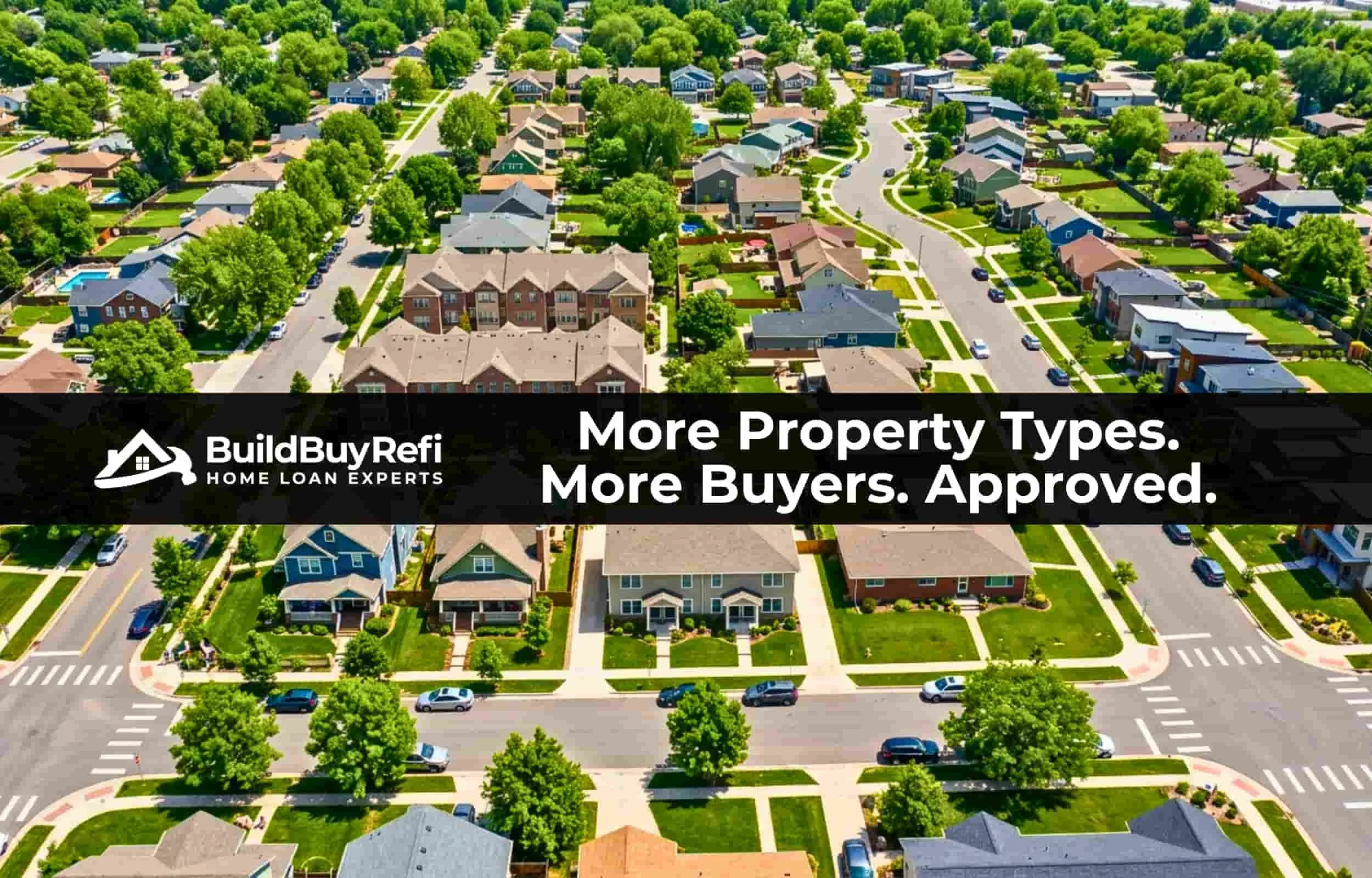
- Single Family Residences (1 unit)
- Duplexes (2 units, owner-occupied)
- Manufactured Homes: Double-Wide and Triple-Wide only (single-wide manufactured homes are NOT eligible for this program)
- Planned Unit Developments (PUDs)
- Townhouses
- Condominiums: Agency-approved or single-unit approval accepted, no litigation
Loan limits follow the applicable FHA county loan limit. The maximum HUD county limit applies to the base FHA first mortgage. High Balance loans are available with both options. Check current county loan limits at buildbuyrefi.com/county-loan-limits.
Homebuyer Education Requirement
All borrowers using the in-house DPA program must complete a homebuyer education course, regardless of first-time buyer status. Fannie Mae's HomeView course is accepted and is free to take online. The course takes approximately four to six hours to complete and provides the certificate needed to satisfy the program requirement.
Start the Fannie Mae HomeView free homebuyer education course at fanniemae.com/education.
Down Payment Assistance Is Not Available on Construction or Renovation Loans
- Down payment assistance is not available on our construction loan programs at this time
- This includes One-Time Close Construction, Two-Time Close Construction, and Hybrid Construction loans
- Down payment assistance is not available on our renovation loan programs at this time
- This includes FHA 203(k) Standard and Limited, VA Renovation, Fannie Mae HomeStyle, and portfolio rehab programs
- DPA applies to standard purchase transactions only, on the eligible property types listed in this page
Buyers who want to build a custom home or renovate a property through our bank should plan for the standard down payment required by the construction or renovation program they select. Construction and renovation programs have their own financing structures that do not permit layered DPA at this time.
If your long-term plan involves building or renovating, one of our bankers can walk you through what down payment contribution is required for those specific programs. We do have Zero down options for Veterans and low-down payment FHA Construction loans too.

National, State, and Local Down Payment Assistance Programs; Let Us Be Your Down Payment Hunters
While the in-house program is the anchor offering on this page, it is not the only down payment assistance program available to buyers we work with. We can review and coordinate with a wide range of national, state, and local down payment assistance programs on a case-by-case basis when our in-house program is not the right fit or is not available in your state, such as New York.
Buyers deserve to know the full landscape of options, not just one product. If you find and qualify for a state program with terms that beat our in-house option, we will tell you. If a local county program offers a better closing credit, we will help you use it when eligible. The goal is to find the best path for each buyer, not to push a single product.
National Down Payment Assistance Programs
A number of national nonprofit and public benefit corporations administer down payment assistance programs that are available across multiple states. These programs operate independently of state housing finance agencies and have their own eligibility rules, funding sources, and combination requirements with participating lenders. We may be able to coordinate with these programs when they apply to your situation.
- National Homebuyers Fund (NHF), a non-profit public benefit corporation that provides down payment and closing cost assistance
- Chenoa Fund, administered by CBC Mortgage Agency, a federally chartered government instrumentality, offers DPA on FHA loans
- Other qualified national programs evaluated based on borrower situation and program alignment with our underwriting
National program eligibility, funding availability, and terms change periodically. A loan officer can tell you which programs are currently active and whether any fit your specific situation. Combining the in-house program with a national program is generally not permitted — these options are alternatives to each other, not stackable.
State Housing Finance Agency (HFA) Programs
Every state has a housing finance agency (HFA) that administers down payment assistance programs, mortgage credit certificate programs, and first-time buyer benefits for residents of that state. Program structures vary widely by state. Some states offer forgivable second liens. Others provide grants that do not have to be repaid. Many offer below-market interest rates on the first mortgage in combination with the DPA component. Most state HFAs require first-time homebuyer status and impose income limits based on household size and county median income.
Some of the most searched state HFAs in the country include:
CalHFA — California Housing Finance Agency, offering the MyHome Assistance Program and CalHFA Conventional and FHA programs
SONYMA — State of New York Mortgage Agency, offering down payment assistance options for New York residents (important given our in-house program is not available in New York)
TDHCA — Texas Department of Housing and Community Affairs, offering My First Texas Home and My Choice Texas Home programs
Florida Housing — Florida Housing Finance Corporation, offering the Florida Assist and Florida Homeownership Loan Program
OHFA — Ohio Housing Finance Agency, offering Your Choice Down Payment Assistance and other state programs
IHDA — Illinois Housing Development Authority, offering Access Forgivable, Access Deferred, and Access Repayable programs
PHFA — Pennsylvania Housing Finance Agency, offering the Keystone Advantage Assistance Loan and HFA Preferred programs
WSHFC — Washington State Housing Finance Commission, offering Home Advantage and House Key State Bond programs
Because we are licensed in all 50 states, there are too many state and local programs to list individually on this page. If you are researching a specific state program, contact us and we will tell you whether your program fits with the first mortgage we would originate for you, what the combined eligibility looks like, and how timing works for closing.
A directory of every state housing finance agency is maintained by HUD at hud.gov/states.
County and City-Level Down Payment Assistance
Beyond state HFA programs, many counties and cities administer their own down payment assistance and closing cost assistance programs funded through local housing trust funds, HUD HOME Investment Partnerships program allocations, Community Development Block Grants (CDBG), and other sources. Local programs vary in structure and often target specific income brackets, first-responder or teacher populations, or specific neighborhoods in revitalization zones.
Local program funding is generally limited, subject to annual appropriation, and often closes when the year's allocation is exhausted. If you are aware of a local program in the county or city you want to buy in, bring it to us and we will tell you whether it combines with the first mortgage programs we offer.
Mortgage Credit Certificate (MCC) Programs
A Mortgage Credit Certificate (MCC) is a federal tax credit program administered at the state level that allows eligible first-time buyers to claim a portion of the mortgage interest they pay each year as a direct federal tax credit. The credit is in addition to the standard mortgage interest deduction. MCC programs are separate from down payment assistance but may be combined with our in-house DPA program in certain states. When both programs apply, buyers can access down payment support at closing AND ongoing tax benefits across the life of the loan.
MCC eligibility is state-specific and generally requires first-time homebuyer status, income limits, and purchase price limits. If you are interested in combining an MCC with our DPA program, ask your loan officer during prequalification. The IRS maintains general MCC program information as part of homeownership tax guidance.
Learn more about the Mortgage Credit Certificate program tax treatment at irs.gov.
What Our New York Residents Should Know
The in-house down payment assistance program we offer is not currently available in New York. However, New York buyers are not without options. The State of New York Mortgage Agency (SONYMA) administers several down payment assistance programs for New York residents. Some New York counties and cities also offer their own DPA programs. We can help New York buyers evaluate those options on a case-by-case basis alongside the first mortgage programs we originate.
If you are a New York resident looking at down payment assistance, contact us directly at 844-999-0639. A loan officer will walk through what New York-specific programs may be available for your situation, income level, and target purchase area.
How Down Payment Assistance Affects Your Monthly Payment
Transparency on this point is essential, and it matters differently depending on which option you choose. The 3-Year Forgivable Option has no impact on your monthly payment during the forgiveness period because no monthly payments are required on the second lien. The 10-Year Repayment Option does add a real monthly payment to your total housing obligation, and you need to understand that payment before you commit to this structure.

Monthly Impact of the 3-Year Forgivable Option
Under the forgivable option, there is no monthly second lien payment during the forgiveness period. Your total monthly housing obligation is limited to the FHA or Conventional first mortgage payment plus property taxes, homeowners insurance, applicable mortgage insurance, and any HOA dues. The second lien has no monthly cost attached to it until the three-year forgiveness period ends or until you sell, refinance, or pay off the loan earlier.
If the three-year owner-occupancy and payment requirements are met, the second lien is forgiven in full and never becomes payable. This is the practical advantage of the forgivable structure for buyers who plan to stay in the home.
Monthly Impact of the 10-Year Repayment Option
Under the 10-year repayment option, the second lien carries an interest rate equal to the first mortgage note rate plus 2%. Monthly payments are not deferred and begin at closing. The monthly second lien payment is calculated using standard amortization over 120 months.
For illustration purposes only, a 10-year repayment second lien of $10,500 (representing 3.5% on a $300,000 purchase) at an interest rate of, for example, 8% (which would reflect an illustrative first mortgage rate of 6% plus 2%) would produce a monthly second lien payment of approximately $127. That amount would be added to the primary mortgage payment. Actual rates, terms, and payments will vary based on market conditions at the time of application and your full credit profile. These numbers are illustrative only.
When you use the repayment option, both the first and second lien payments are included in your debt-to-income ratio for qualification purposes. Your loan officer will evaluate your combined obligation during prequalification and confirm that the structure fits your budget and automated underwriting approval.
Illustrative Borrower Scenarios: How Down Payment Assistance Applies Across Different Profiles
The following scenarios are illustrative examples designed to help readers understand how down payment assistance applies in real situations. They do not represent actual transactions and are not a guarantee of eligibility, approval, or specific loan terms. All programs described are subject to underwriting approval and program guidelines.

Scenario 1: First-Time Buyer Planning to Stay Long-Term
A buyer with household income of $58,000 per year, a 640 credit score, and stable employment has been renting for six years at $1,500 per month. The buyer has $4,000 saved and has identified a $240,000 FHA purchase with an estimated monthly payment comparable to current rent. The 3.5 percent required down payment alone is $8,400. Closing costs add several thousand more.
In a situation like this, the 3-Year Forgivable Option may be appropriate. The second lien covers the down payment and a portion of closing costs. Because no monthly second lien payment is required during the forgiveness period, the borrower's total monthly housing cost stays close to the FHA first mortgage payment plus tax and insurance. If the buyer stays in the home for three years without default, the second lien is forgiven entirely. Subject to underwriting approval and program guidelines.
Scenario 2: Buyer Who May Refinance or Sell Within Three Years
A buyer with a $72,000 household income purchasing in a market where rates are high but expected to decline. The buyer expects to refinance within two to three years once rates drop. The standard FHA 3.5 percent down payment exceeds current savings.
In this scenario, the 10-Year Repayment Option may be the better choice even though it requires a monthly second lien payment. Because the forgivable option would become payable if refinanced before three years, the repayment structure avoids forgiveness-period surprise. The monthly second lien payment is known and predictable. Subject to underwriting approval and program guidelines.
Scenario 3: Repeat Buyer Without First-Time Status
A buyer who owned a home eight years ago, relocated, sold the property, and has been renting since. Prior homeownership disqualifies them from many state-run DPA programs that require first-time buyer status. The buyer has rebuilt credit but has not accumulated sufficient down payment funds while renting.
The in-house DPA program we offer does not require first-time homebuyer status, which makes it particularly useful for repeat buyers in this position. Either option may apply depending on the buyer's occupancy plans and monthly budget preference. Subject to underwriting approval and program guidelines.
Scenario 4: New York Buyer Needing State-Level DPA Support
A buyer in New York with qualifying income and credit, who needs down payment assistance to close on a home. Because the in-house DPA program we offer is not available in New York, the buyer cannot use the forgivable or repayment options on this page. However, SONYMA and various county programs in New York offer DPA options that can be combined with our first mortgage programs.
We can originate the first mortgage in New York while helping coordinate the state or county DPA that fits the buyer's profile. Subject to underwriting approval, state program availability, and program guidelines.
Scenario 5: Moderate-Income Household in Higher-Cost Market
A household with combined income of $95,000 is purchasing in a market where median home prices are $380,000. A 5 percent down payment on that purchase is $19,000. The household qualifies on income and credit but has $9,000 in savings and does not want to drain reserves. A DPA structure allows the household to preserve savings while covering the required down payment through the subordinate lien. Depending on the loan structure selected and automated underwriting approval, either the FHA-paired program up to 101.5% CLTV or a Conventional-paired structure may apply. Subject to underwriting approval and program guidelines.
Reasons Why Some Down Payment Assistance Applications may be Declined
Not every buyer who inquires about down payment assistance will qualify, and not every DPA structure will work for every transaction. Understanding the most common reasons applications do not proceed helps buyers prepare more effectively and identify alternative approaches.
Automated Underwriting Did Not Return an Approval
The in-house DPA program requires an Approve/Eligible result from DU or LP for the no-maximum-DTI structure. If the borrower's credit profile, income documentation, or debt structure does not produce that result, the transaction can only proceed under the manual underwriting path, which requires a 660 minimum FICO and a 45.0 maximum DTI. In some cases, addressing specific credit factors or adjusting the purchase price resolves the AUS result.
FICO Score Below 600
The in-house DPA program requires a minimum 600 FICO per borrower. Buyers with scores below that threshold are not eligible for this specific program. A loan officer can identify credit-rebuilding steps that may help reach the qualifying threshold, or evaluate alternative loan programs that may work with a lower credit profile.
Property Type or Occupancy Not Eligible
The program applies to owner-occupied primary residences on eligible property types. Investment properties, second homes, non-owner-occupied transactions, and single-wide manufactured homes are not eligible. Condos with pending litigation, properties requiring significant repairs, and certain unique property types may not meet program guidelines.
Construction or Renovation Transactions
Down payment assistance is not available on our construction or renovation programs. Buyers pursuing a new build or rehab-style purchase need to plan for the standard down payment contribution required by the construction or renovation program they select.
Co-Signer Instead of Co-Borrower
The program does not permit co-signers, which is a distinction from non-occupant co-borrowers. Non-occupant co-borrowers are allowed if they are on title. If a proposed structure involves a co-signer who will not be on title, the transaction cannot proceed under this program.
Homebuyer Education Certificate Not Completed
All borrowers must complete a homebuyer education course before closing. Fannie Mae's free HomeView course satisfies the requirement. Buyers who have not completed the course may delay closing until the certificate is obtained.
What to Do If Your Application Does Not Move Forward
An initial decline is not a permanent answer. Our bankers can walk through specific factors affecting the result and identify potential paths, including credit improvement, alternative loan programs, national or state DPA programs that may have different eligibility criteria, or adjusted loan structures. Do not assume a decline from another lender closes all options. Call 844-999-0639 to have your file reviewed.
Before You Apply for Down Payment Assistance: A Preparation Checklist
Buyers who arrive at prequalification with documentation organized move through the process faster. The following checklist covers what is typically needed to evaluate a DPA scenario. Your loan officer may request additional documentation based on your situation.
You may also need additional documentation not listed below if you are self-employed, or a 1099 contractor.
- Most recent two years of W-2 forms for all wage earners on the application
- Most recent two years of complete federal tax returns with all schedules, if self-employed or with variable income
- Most recent 30 days of pay stubs for all wage earners
- Most recent two months of complete bank statements for all accounts, including all pages
- Government-issued photo identification
- Authorization for a soft credit pull (does not affect your credit score)
- Current monthly debt obligations including all installment and revolving accounts
- Property address if already under contract
- Gift fund documentation if applicable, including donor letter and transfer verification
- Explanation letter for any significant deposits, employment gaps, or credit events in the past 24 months
- Plan to complete Fannie Mae's free HomeView homebuyer education course before closing
Estimate Your Cash-to-Close Before You Apply
The calculator below walks through the same math a loan officer uses to estimate your cash-to-close with and without down payment assistance. You can toggle between the two options to compare. Results are illustrative only and not a guarantee of qualification or specific loan terms. When you are ready for a real income and structure review, call 844-999-0639 or start the eligibility form.
Frequently Asked Questions About Down Payment Assistance
How much down payment do I need to buy a house?
Required down payment varies by loan program. FHA requires a minimum 3.5 percent. Conventional programs may require as little as 3 percent for eligible first-time buyers or 5 percent for other borrowers. USDA Rural Development and VA do not require a down payment for eligible buyers. Down payment assistance is a tool for buyers who cannot meet the minimum requirement through savings alone.
Is the down payment assistance program really forgivable?
The 3-Year Forgivable Option is genuinely forgivable after three years of continued owner-occupancy with no default on the FHA first mortgage. No monthly payments are required during the forgiveness period. No interest accrues. If the conditions are met at the 3-year mark, the second lien is forgiven in full. However, if the home is sold, refinanced, or paid off before the three-year period ends, the full second lien balance becomes payable at that time. The 10-Year Repayment Option is not forgivable; it is a standard amortizing second lien.
Can I use down payment assistance for closing costs?
Yes. Unlike many DPA programs that only cover the down payment, the funds from the in-house program we offer may be used for down payment and closing costs. This is a meaningful advantage, particularly for buyers who have some savings but not enough to cover both categories of upfront expense.
Is first-time homebuyer status required?
No. The in-house DPA program does not require first-time homebuyer status. Repeat buyers who meet program eligibility may apply. Note that many state-run and nonprofit DPA programs do require first-time buyer status, which is one reason our in-house program is useful for buyers who have owned a home before.
Are there income limits?
Not on the in-house program beyond what automated underwriting approval requires. Many state-run DPA programs have strict income caps based on household size and area median income. Our program does not impose a separate income cap, which makes it available to a broader range of household incomes than most state programs.
What is the minimum credit score?
The in-house DPA program requires a 600 minimum FICO score per borrower. Manual underwrites require a 660 minimum FICO and a 45 percent maximum DTI. For the no-maximum-DTI structure, a DU or LP Approve/Eligible result is required.
Is this program available in all 50 states?
The in-house program is available in 49 states. It is not currently available in New York. The 3-Year Forgivable Option is additionally not available in Washington State. For buyers in those states, we support national, state, and local DPA programs on a case-by-case basis and can still originate your first mortgage.
What property types are eligible?
Single Family Residences (1 unit), Duplexes (2 units), Manufactured Homes (double-wide and triple-wide only; single-wide is not eligible), PUDs, Townhouses, and Condominiums (agency-approved or single-unit approval with no litigation).
Can I combine down payment assistance with an MCC?
In some states, yes. Mortgage Credit Certificate programs are state-administered and may combine with our in-house DPA in jurisdictions where both programs are available. Your loan officer can confirm whether MCC layering is available in your state during prequalification.
Can I use DPA on a construction loan or renovation loan?
No. Down payment assistance is not available on our construction or renovation loan programs at this time. This includes One-Time Close Construction, Two-Time Close Construction, Hybrid Construction, FHA 203(k), VA Renovation, Fannie Mae HomeStyle, and portfolio rehab programs. DPA applies only to standard purchase transactions.
What happens if I refinance before the forgiveness period ends?
If you chose the 3-Year Forgivable Option and refinance before the three-year forgiveness period is complete, the full second lien balance becomes payable at the time of refinance. The second lien cannot be subordinated to a new first mortgage. Buyers planning to refinance within three years generally choose the 10-Year Repayment Option instead for that reason.
Are non-occupant co-borrowers allowed?
Yes, non-occupant co-borrowers are allowed and must be on title. Co-signers (who are not on title) are not allowed under this program.
What does the homebuyer education requirement involve?
All borrowers must complete a homebuyer education course and provide the completion certificate before closing. Fannie Mae's HomeView course satisfies the requirement and is free. The course takes roughly four to six hours to complete online.
Can down payment assistance be combined with gift funds?
Gift funds from eligible donors are permitted under FHA and Conventional guidelines generally. In most cases using our DPA, the second lien covers the required down payment and additional gift funds are not needed. However, gift funds from eligible sources may be used for closing costs or reserves subject to standard documentation requirements.
How long does the DPA process add to closing?
Because our in-house DPA program uses delegated underwriting and funds do not depend on third-party approval cycles, DPA transactions close on the same timeline as any other purchase mortgage we originate. There is no separate state-agency underwriting wait required for the in-house program. State-run DPA programs that we may coordinate with can have longer timelines depending on the program.
Important Program Disclosures and Risk Considerations
Risk Considerations Before Applying
Down payment assistance provides a structured path to purchase, but it involves real obligations and real risks that must be understood before proceeding.
The 10-Year Repayment Option creates a real monthly payment obligation on top of your primary mortgage. It is not a grant and it is not forgiven. Buyers who use this option must budget for the combined monthly payment.
The 3-Year Forgivable Option is forgiven only if specific conditions are met. If the home is sold, refinanced, or no longer owner-occupied before the three-year mark, or if the FHA first mortgage goes into default, the full second lien balance becomes payable at that time.
Neither option can be subordinated to a new first mortgage during the active period. If you refinance, the second lien must be paid off as part of the transaction or, in the case of the forgivable option past the forgiveness date, may be released.
Program availability, underwriting guidelines, and program terms are subject to change. Information on this page describes the program as generally structured at the time of publication and should not be relied upon as a guarantee of future program availability or terms.
Not all properties will qualify. Not all borrowers will qualify. Subject to underwriting approval and program guidelines.
Combined Loan-to-Value and Equity Position at Closing
When combined loan-to-value reaches 100 percent or 101.5 percent of the purchase price, the buyer has no equity in the property at closing. This is a meaningful distinction from a traditional purchase where the buyer brings a down payment from savings. In the early years of ownership, the ability to refinance, sell, or access home equity may be limited until sufficient equity accumulates through payments and appreciation. Buyers should evaluate this reality as part of their long-term financial planning.
How We Make Money
The Federal Savings Bank earns revenue when residential mortgage loans are funded. BuildBuyRefi.com does not receive referral fees from down payment assistance funding sources. When real estate commission savings are facilitated through our participating real estate firm, that arrangement is handled between the consumer and the brokerage. The bank and individual bankers do not receive remuneration from commission savings transactions. Full fee disclosure is provided in writing as part of the Loan Estimate and Closing Disclosure process.
Why You Can Trust This Information
Written by the BuildBuyRefi.com Lending Team and reviewed by our Compliance Team prior to publication
Published by a federally chartered, FDIC-insured institution operating under NMLS# 411500
Updated April 20, 2026 with current program structure, availability, and eligibility rules
Structured under federal lending guidelines and applicable state regulations in all 50 states
External references to Fannie Mae, FHA, HUD, VA, USDA, CFPB, NMLS, and IRS included throughout for independent verification
Privacy Policy and Terms and Conditions linked at the bottom of every page
Lending team available 7 days a week at 844-999-0639 to answer specific questions
Program Oversight and Content Review
The content on this page is written and maintained by the lending operations and compliance functions at BuildBuyRefi.com, powered by The Federal Savings Bank. Content is reviewed before publication and updated as needed when regulatory guidance, program guidelines, or federal agency handbooks are revised. When program terms or state availability change, the last-updated date at the top of the page is revised and a corresponding change log entry is recorded. If you believe any information on this page is outdated or inaccurate, please reach out through the Consumer Support section below so we can review.
About BuildBuyRefi.com and The Federal Savings Bank
BuildBuyRefi.com is powered by The Federal Savings Bank, a federally chartered institution and one of the largest privately held veteran-owned banks in the United States. The Federal Savings Bank underwrites, funds, and services residential mortgage loans in-house across all 50 states. It is not a broker. All loans close in the name of The Federal Savings Bank. The institution is Member FDIC, Equal Housing Lender, and has been independently recognized by national publications, consumer platforms, and industry organizations for mortgage lending excellence. Licensing can be verified at any time through NMLS Consumer Access using NMLS# 411500.
- Best Overall Construction Lender, Investopedia
- Best VA Construction Lender, Investopedia
- Best Manufactured Home Lender, Investopedia
- Top Mortgage Workplaces, Mortgage Professionals Association
- Top Rated Local Winner, 2019 and 2020
- Featured in national publications and broadcast
- As Featured In Investopedia, The Mortgage Reports, Military.com, BobVila.com, Military Makeover with Montel
Consumer Support and Contact Information
Our lending team is available to answer questions about income documentation, program eligibility, state DPA coordination, construction financing, and all other aspects of the mortgage process.

Ready to Find Out If You Qualify for Down Payment Assistance?
If your income supports a mortgage payment but the required down payment is the obstacle, the next step is a prequalification conversation with a banker. Prequalification uses a soft credit pull that does not affect your credit score and can be completed quickly.
Whether you are considering the 3-Year Forgivable Option, the 10-Year Repayment Option, or a state or local program we coordinate with, a loan officer can review your full financial picture and recommend the path that fits.
You do not need to have a property under contract to start. Many buyers benefit from understanding what they qualify for before beginning their home search.
Regulatory and Licensing Transparency
BuildBuyRefi.com operates as a division of The Federal Savings Bank. Residential mortgage loans originate and close in the name of The Federal Savings Bank. Consumers can verify licensing at any time through the Nationwide Multistate Licensing System Consumer Access portal.
The optional unsecured consumer loan of up to *$50,000 is a separate program from the down payment assistance described on this page. Not all consumers will qualify. Subject to credit approval. Consumer loan proceeds may not be used for down payment or to satisfy minimum required borrower investment.
Real estate commission savings through our participating real estate firm are a separate program and are not a component of mortgage loan origination.
Written by the BuildBuyRefi.com, powered by The Federal Savings Bank Lending and Compliance Team | NMLS# 411500 | Compliance Reviewed | Last Updated: April 25, 2026